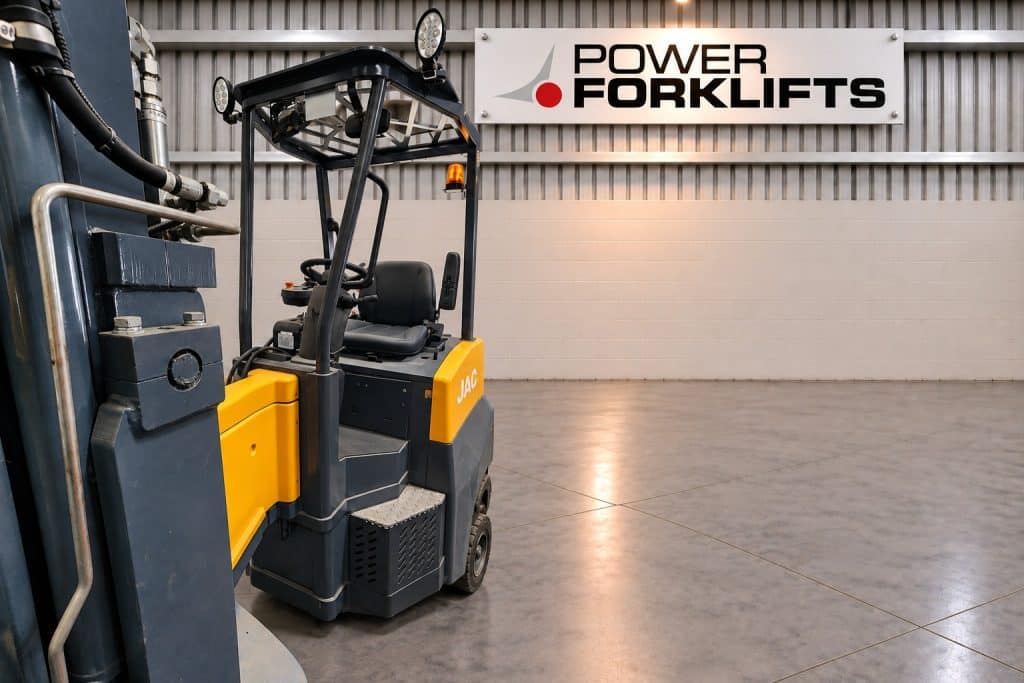
By the Power Forklifts team, with advice from Jaco Lubbe, Business Development Manager at Power Forklifts. Updated November 2026.
If your warehouse is running out of room, the forklift you choose can matter as much as the racking. Reach trucks and articulated forklifts (such as the Aisle Master, Bendi and JAC MJ20) are both narrow-aisle machines, but they suit different operations. Here’s how to choose.
The short answer
- Choose a reach truck when speed, productivity and high pallet volumes come first, and your aisles are a conventional width.
- Choose an articulated forklift when floor space is limited, storage density is critical, or extra warehouse space is expensive.
Reach trucks: built for speed
“Reach trucks are typically the preferred choice when warehouse space is not a major constraint,” says Jaco Lubbe, Business Development Manager at Power Forklifts. “They are fast, highly manoeuvrable, and ideal for high-volume warehousing operations where productivity and rapid pallet movements are the primary focus.”
As an example, the JAC CQD16 reach truck lifts 1.6 tonnes, turns in a 1,690mm radius, and needs a minimum right-angle stacking aisle of about 2,911mm with a 1100×1100mm pallet. Reach trucks are mainly designed for smooth indoor floors.
Articulated forklifts: built for space
An articulated forklift bends in the middle, so it can turn into the racking from a much narrower aisle than a reach truck or a standard forklift. Combilift says its Aisle Master can work in aisles as narrow as 1.6 metres and lift up to 15 metres, increasing storage capacity by up to 50%. Articulated forklifts can also work indoors and outdoors, so one machine can unload a truck in the yard and put the pallet away in a narrow aisle.
“Articulated forklifts are designed for operations where maximising storage space is the priority,” says Jaco. “They can operate in significantly narrower aisles than traditional forklifts or reach trucks, allowing businesses to install more racking and increase pallet positions without expanding the building footprint.”
Design the warehouse around the forklift, not the other way round
A common mistake is choosing a forklift first, then laying out the racking around its turning circle. With an articulated forklift, you can do the opposite. Plan much narrower aisles from the start, while still reaching full-height racking, often up to 10 metres or more.
A business near us is doing exactly that with a new warehouse. Instead of buying forklifts after the racking was designed, they planned the building around an articulated Aisle Master. That lets them narrow the aisles and fit more pallet locations into the same footprint, adding significant storage capacity without making the building any bigger.
The trade-off
Articulated forklifts are generally not as fast as reach trucks in high-throughput work. Their strength is making the most of your space, not maximum travel speed. “In many cases, the savings achieved through improved space utilisation can outweigh the additional investment in an articulated forklift,” Jaco says, especially for growing businesses where warehouse space is at a premium.
Side-by-side comparison
| Reach truck | Articulated forklift | |
|---|---|---|
| Main strength | Speed and high pallet throughput | Storage density in narrow aisles |
| Typical aisle | About 2.8–3.0m (JAC CQD15L to CQD20) | As narrow as about 1.6m (Aisle Master) |
| Indoor or outdoor | Mainly indoor, smooth floors | Indoor and outdoor models |
| Truck unloading | Limited | Yes. It can unload in the yard and put away in the racking |
| Best for | Busy distribution centres with conventional aisles | Sites short on space, or where extra floor area is costly |
Aisle widths depend on the model, pallet size and racking layout. Ask us for a layout check before you commit.
Questions to ask before you decide
- How many pallet movements do you do per hour or per shift?
- Are you short on pallet positions, or short on speed?
- What would extra warehouse space cost you to lease or build?
- Do you need to unload trucks outside, as well as store inside?
- How high is your racking now, and in 3–5 years?
Frequently asked questions
What is an articulated forklift?
A forklift that pivots in the middle, so the front section and mast turn independently of the rear. This lets it turn into racking from very narrow aisles.
Is an articulated forklift faster than a reach truck?
Generally, no. Reach trucks are faster in high-throughput work. Articulated forklifts win on storage density and versatility.
How narrow can a warehouse aisle be?
With an articulated forklift such as the Aisle Master, aisles can be as narrow as about 1.6m. A reach truck such as the JAC CQD16 needs about 2.9m with a standard pallet.
Talk to us about your layout
Power Forklifts sells and services JAC reach trucks and the JAC MJ20 articulated forklift, plus used Aisle Master and Bendi articulated forklifts. Send us your floor plan and racking heights and we’ll help you work out which option gives you the most storage and productivity. Call 09 838 0023, or browse reach trucks, new forklifts and used forklifts.
Related: 6 forklift buying mistakes to avoid.