
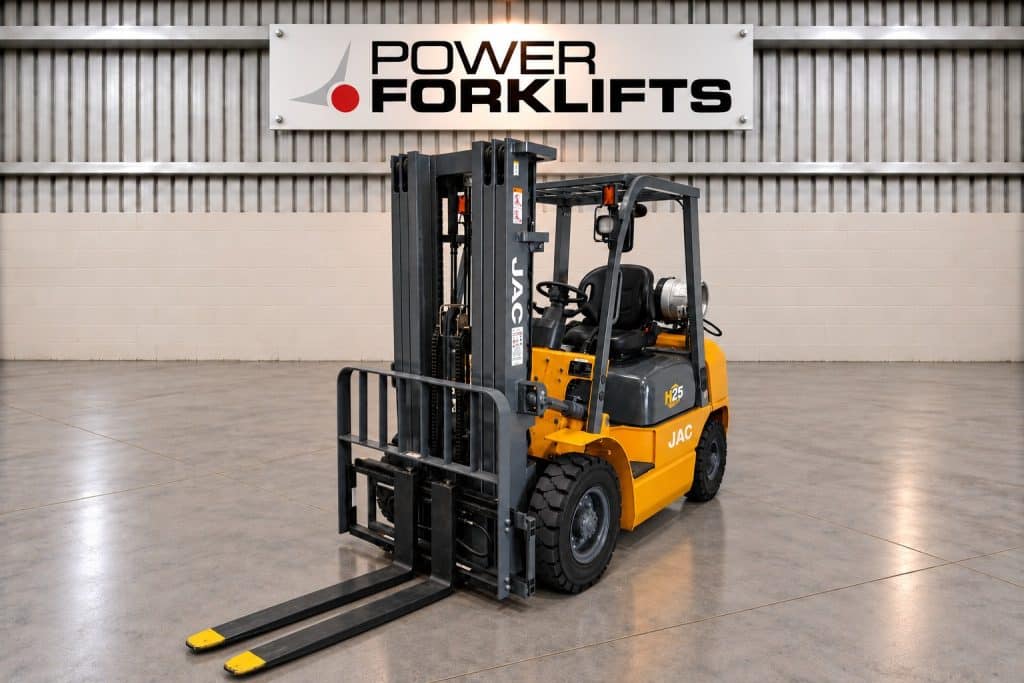
By the Power Forklifts team, with advice from Jaco Lubbe, Business Development Manager at Power Forklifts. Updated November 2026.
Most forklift problems we see don’t come from a bad machine. They come from a forklift that was the wrong fit for the job. Here are the most common buying mistakes we see, how to avoid them, and when to choose a triplex mast over a duplex.
Mistake 1: Buying for today instead of the next 3–5 years
“One of the most common mistakes buyers make is purchasing a forklift that is too small for their future requirements,” says Jaco Lubbe, Business Development Manager at Power Forklifts. Buyers focus on today’s job and the purchase price, and forget about growth: more racking, heavier loads, more pallets a day.
“It is not uncommon for businesses to outgrow their forklift within 12 to 24 months,” Jaco says. The result is lost productivity and an early, expensive upgrade. His advice is to size the forklift “not only for today’s needs but also for where the business is likely to be in the next three to five years.”
Mistake 2: Ignoring capacity at height
A forklift’s rated capacity, say 2.5 tonnes, applies at a set load centre (usually 500mm) and at a lower lift height. Lift higher, or carry a longer or deeper load, and the safe capacity drops. As an example, on a 4.8m triplex mast at a 500mm load centre:
| Rated capacity | Capacity at 4.8m lift height |
|---|---|
| 1.8 t | about 1,400 kg |
| 2.5 t | about 1,700 kg |
| 3.0 t | about 2,400 kg |
| 3.5 t | about 2,900 kg |
If your heaviest pallet weighs 1,800 kg and goes on the top rack at 4.5m or more, a 2.5 tonne forklift is not enough. Always check the load chart on the machine’s load plate against your heaviest load at your highest racking. WorkSafe’s training code reminds operators that the rated capacity at height can be much less than the nominal capacity, and must never be exceeded.
Mistake 3: A mast that’s too tall for your site
Measure every doorway, roller door, mezzanine, roof beam and sprinkler pipe the forklift has to pass under. Also measure any container or truck curtain it has to work inside. A standard shipping container door opening is only about 2.26–2.28m high, and a high cube is about 2.56–2.59m.
The figure to check is the mast’s lowered (collapsed) height, along with the height of the overhead guard. Don’t go by the maximum lift height alone.
Mistake 4: Not checking aisle widths and turning circles
A forklift that can’t turn into your aisle with a pallet on the forks will slow the whole operation down, or damage racking. Measure your narrowest working aisle and compare it with the forklift’s right-angle stacking aisle figure on the specification sheet. If your aisles are tight, see our guide to articulated forklifts vs reach trucks.
Mistake 5: Buying on price alone
The cheapest forklift up front isn’t always the cheapest to own. Jaco recommends comparing the total cost of ownership: running costs, servicing, parts availability, reliability, downtime and resale value. A machine with local service support and parts on the shelf keeps working. One without can sit idle for weeks waiting on a part.
Mistake 6: Forgetting future racking, loads and shifts
Will you add a higher row of racking next year? Take on heavier products? Add a second shift? Each of these changes what you need: more capacity at height, a taller mast, or a battery or fuel type that suits longer hours. Tell your supplier where you’re heading, not just where you are now.
Triplex vs duplex masts: which do you need?
A duplex (2-stage) mast has two sections. A triplex (3-stage) mast has three, so it can reach a similar or greater height from a much lower collapsed height. Most triplex masts also have full free lift: the forks can rise well over a metre before the mast itself gets any taller.
Here is how a 2–2.5 tonne JAC J Series compares:
| Duplex 4.5m | Triplex full free lift 4.8m | |
|---|---|---|
| Lowered height | 2,795 mm | 2,145 mm |
| Free lift (forks rise before the mast extends) | None | 1,150 mm (with backrest) |
| Fits through a standard container door (about 2.26–2.28m)? | No | Yes, the mast clears it (check overhead guard height too) |
“I generally recommend a triplex mast for most modern applications,” says Jaco. “A triplex mast offers a lower collapsed height while providing significantly greater lift height, making it ideal for warehouses with limited doorway clearance, container loading, and higher storage racking.” Free lift lets operators raise and stack loads inside a container or under a low ceiling without the mast getting any taller.
When a duplex still makes sense: basic jobs where lift heights are low and overhead clearance isn’t an issue. Even then, a triplex gives you room to grow, which is why nearly all the new JAC forklifts we stock come with a 4.8m full free lift triplex mast.
Quick buyer’s checklist
- Heaviest load, and its size (load centre)
- Highest racking level, now and in 3–5 years
- Lowest doorway, roof or obstruction, and any container or truck work
- Narrowest aisle
- Indoor, outdoor or both, and the floor surface
- Hours per day and number of shifts (this affects your fuel or battery choice)
- Service, parts and support from your supplier
Frequently asked questions
What size forklift do I need?
Start with your heaviest load at your highest lift height, then check the forklift’s load chart at that height. Allow for growth over the next 3–5 years.
Is a triplex mast better than a duplex?
For most modern sites, yes. A triplex mast has a lower lowered height, more lift height and full free lift, so it can work in containers and under low doorways. A duplex suits simple, low-lift jobs with plenty of overhead clearance.
Can a forklift fit in a shipping container?
Many can, if the mast’s lowered height and the overhead guard are under the container door height (about 2.26–2.28m on a standard container). A triplex mast with full free lift lets you stack inside without the mast hitting the roof. Check your forklift’s specification before you try.
Get the right fit
Tell us your heaviest load, racking height, doorways and aisles, and we’ll recommend the right forklift and mast. Call 09 838 0023, or browse new forklifts in stock and our counterbalanced range. Comparing power types? Read LPG vs diesel vs electric vs lithium forklifts.
No Comments yet!